Physical Address
304 North Cardinal St.
Dorchester Center, MA 02124
Physical Address
304 North Cardinal St.
Dorchester Center, MA 02124
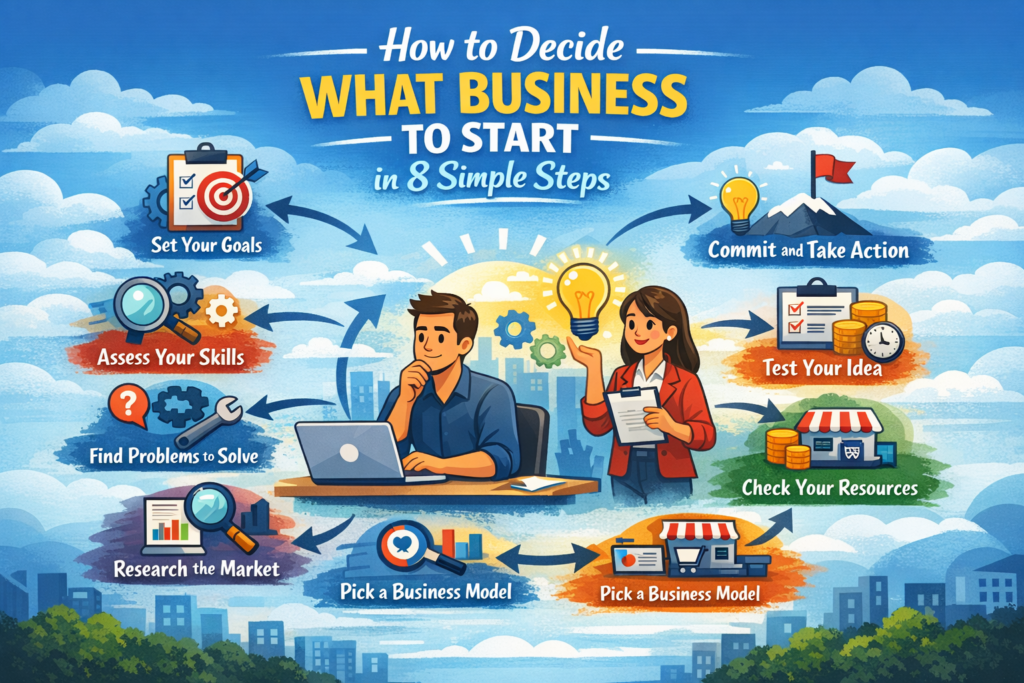
Choosing a business becomes much easier when you first decide what kind of life you want that business to support. Some people want quick side income. Others want to leave their job, work from home, travel, or build something they can scale and maybe sell later. Those goals matter because different businesses create very different lifestyles. A service business can bring in cash faster, while digital products or content businesses may take longer but offer more flexibility over time. When you know whether you want speed, freedom, stability, or long-term scale, you can eliminate ideas that do not truly fit.
The best business ideas often begin with what you already know. Many people think they need a completely new idea, but a lot of strong businesses are built from existing skills, work experience, or interests. Think about what people already ask you for help with. It might be writing, design, organizing, teaching, sales, cooking, content creation, ecommerce, or fixing things. Starting from your strengths gives you momentum. You do not need to be the best in the world, but you should choose something you can improve quickly and stay interested in long enough to grow.
A business makes money by solving a problem or helping someone get a result. That is why the best business ideas usually come from real pain points, not just “cool” concepts. Ask yourself what frustrates people in the areas you understand. Maybe small businesses need better branding, creators need design templates, families need help staying organized, or sellers need easier shipping solutions. The clearer the problem, the easier it is to build an offer around it. When your business idea is tied to a specific need, selling becomes much easier because you are offering help, not just trying to convince people to buy something.
One of the smartest things you can do is validate demand before you commit too much time or money. A business idea sounds much stronger when there is proof that people are already searching for it, talking about it, or spending money on it. You can check marketplaces, search trends, social media, online communities, and competitor websites to see what already exists. Competition is not always a bad sign. In many cases, it proves there is a market. The goal is not to find an idea with zero competition. It is to find a market with demand and then figure out how you can serve it in a clearer, better, or more focused way.
Different business models work in different ways. Some businesses sell services. Others sell physical products, digital products, subscriptions, memberships, coaching, or content supported by ads and affiliate income. It is easier to decide what business to start when you understand how the model actually makes money. Service businesses can bring income faster. Product businesses may take longer to set up but can scale more easily. Digital products can offer high margins because you create them once and sell them many times. Choose a model that feels simple enough for you to test without getting overwhelmed.
Not every good business idea is right for you right now. You need to be honest about your current time, energy, money, and risk tolerance. If you have little capital, a business that needs inventory may be harder to start than a service or digital product. If you have a full-time job, a business that fits part-time hours may be a better first step. If you want low overhead, online models may make more sense than local physical ones. The best business is not just one that sounds profitable. It is one you can realistically launch and keep going without burning out.
You do not need a perfect launch to know whether an idea has potential. In fact, one of the smartest ways to choose a business is to run a small test first. Offer one service, create one digital product, list a few products, or build a simple landing page and see how people respond. A small test gives you real feedback without huge risk. It shows whether people are interested, whether they understand your offer, and whether they are willing to pay. This helps you move from guessing to learning. Many of the best businesses begin as small experiments, not giant polished launches.
At some point, you have to stop overthinking and make a decision. Many people stay stuck because they want certainty before they begin. But clarity often comes after action, not before it. Pick the business idea that best fits your skills, the problem you can solve, your lifestyle, your resources, and real market demand. Then commit to it for a meaningful period of time. Give it space to grow. You can always improve, shift, or pivot later, but you need to move first. The biggest mistake is not choosing the wrong business. It is never choosing at all.
Deciding what business to start does not need to feel confusing forever. When you break it into simple steps, the process becomes much clearer. Start with your life goals, your strengths, and the problems you can solve. Check the market, choose a simple model, test the idea, and commit long enough to learn from real results. The right business is usually not the flashiest one. It is the one that fits you, helps people, and has room to grow.