Physical Address
304 North Cardinal St.
Dorchester Center, MA 02124
Physical Address
304 North Cardinal St.
Dorchester Center, MA 02124
Working from home sounds ideal to many people. No commute, more flexibility, comfortable clothes, and the ability to manage your own environment. But once the excitement wears off, remote work can also become mentally exhausting. The lines between work and personal life get blurry, the days start to feel repetitive, and it becomes surprisingly easy to feel distracted, isolated, or burned out.
That is why staying sane while working from home is not just about productivity. It is about protecting your focus, your energy, and your mental well-being. Remote work can be amazing, but only when you build habits that make it sustainable. Without structure, even a good setup can start to feel draining.
If you work from home full-time, part-time, or run your own online business, these tips can help you stay more balanced, focused, and mentally healthy.
One of the easiest ways to feel off while working from home is to roll out of bed and go straight into work mode. It may seem efficient, but for many people it makes the whole day feel messy and rushed. Your brain benefits from a transition between home life and work life, even if both happen in the same place.
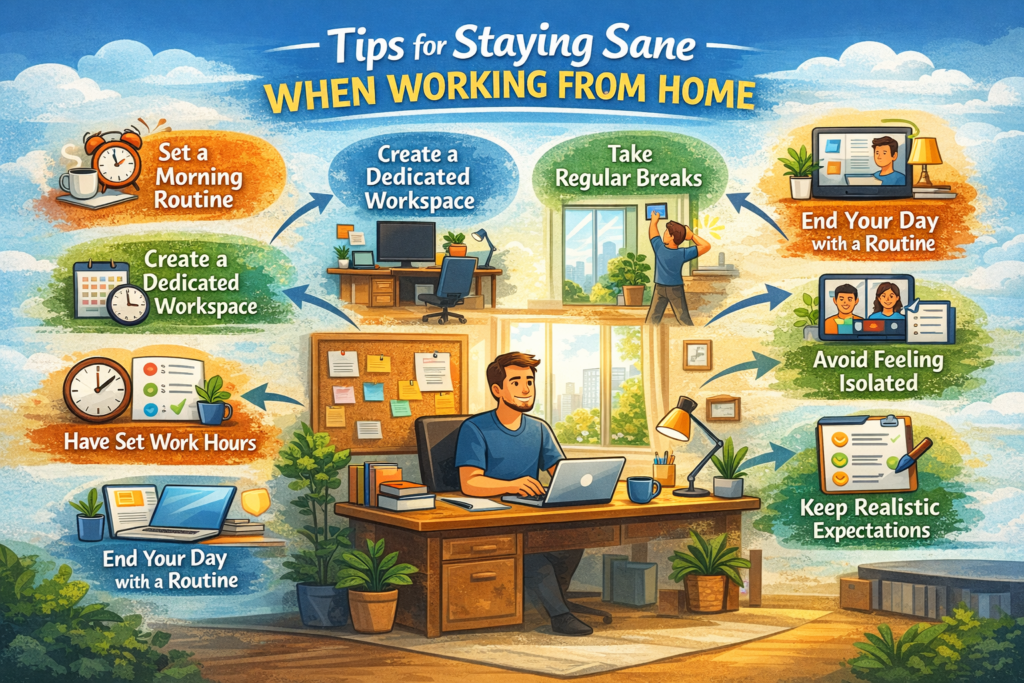
A simple morning routine can make a big difference. You do not need anything complicated. Wake up at a reasonable time, get dressed, wash up, make coffee or breakfast, and take a few minutes to prepare mentally before opening your laptop. The goal is to create a real beginning to the day so your work does not feel like it starts the second you open your eyes.
One of the biggest problems with working from home is that work can quietly spread into every part of the day. You check one email after dinner, answer one message late at night, and suddenly your workday never really ends.
Setting work hours helps protect your mind. Even if your schedule is flexible, choose a general start time and finish time. This creates boundaries and gives your day shape. It also helps reduce guilt because you know when you are working and when you are off.
Working from home does not mean being available all the time. In fact, having no limits is one of the fastest ways to burn out.
You do not need a huge home office to work well from home, but it helps to have a space that your brain associates with work. If possible, avoid working from bed or from the couch all day. Those spaces are meant for rest, and when they become your office too, it can make it harder to focus during work and harder to relax later.
Even a small desk in a corner can help. The point is not perfection. The point is separation. A dedicated workspace tells your mind, “This is where work happens.” That small mental shift can make remote work feel much less chaotic.
When people work from home, they often fall into one of two extremes. Either they get distracted constantly, or they sit in the same spot for hours without moving. Neither feels good over time.
Short breaks are important for staying sane. Step away from the screen, stretch, get water, walk around, or just look outside for a few minutes. These breaks help reset your attention and reduce that trapped, mentally foggy feeling that can build up after too much screen time.
You do not need long breaks every hour, but regular small pauses can improve both your mood and your concentration.
One of the hardest parts of working from home is the feeling that every day happens in the same few rooms. Even if you like being at home, too much time indoors can make life feel stale and heavy.
Try to leave the house regularly, even if it is just for a short walk, a coffee run, groceries, or sitting outside for a bit. Fresh air and a change of environment can improve your mental state more than you might expect. If your whole world becomes laptop, room, kitchen, repeat, your mind can start to feel stuck.
You do not need to turn every day into an outing. But giving yourself regular movement and a change of scenery helps remote life feel more human.
Working from home can create pressure to prove that you are working hard enough. Because no one sees you, you may overcompensate by trying to be productive every second. This usually backfires.
No one works at full speed all day. Real productivity comes in waves. Some parts of the day will be focused and efficient. Other parts will be slower. That is normal. The goal is not constant output. The goal is meaningful progress.
When you stop expecting yourself to operate like a machine, working from home becomes much less stressful. Focus on results, not nonstop motion.
One subtle reason remote work can feel mentally draining is the number of small decisions you make all day. When do I start? What do I work on first? Should I answer messages now? Should I eat now? Should I take a break? This constant self-management can wear you down.
Simple routines help reduce that pressure. Decide in advance when you start, what your first task is, when you usually eat, and when you normally stop. Structure removes some of the mental noise. You do not need to plan every minute, but having a few predictable patterns can make the day feel less overwhelming.
Working from home can be peaceful, but it can also get lonely. If you live alone or spend most of the day in silence, that isolation can slowly affect your mood without you realizing it.
Try to stay connected in small ways. Talk to friends, call family, check in with coworkers, or spend some time around other people during the week. Even light interaction can make a difference. If you are self-employed, this matters even more because there may be no built-in social contact in your workday.
Human connection helps balance the solitude of remote work. You do not need constant conversation, but you do need some real contact.
One of the best things you can do for your sanity is create an end-of-day routine. When you work from home, there is no commute to separate work from personal life, so you need another signal that says, “The workday is finished.”
That could mean shutting down your laptop, clearing your desk, writing tomorrow’s task list, or taking a walk after work. The habit itself matters more than the exact routine. You are giving your brain closure.
Without that ending, work tends to stay mentally open all evening, even if you are technically off the clock.
Some days at home will feel productive and calm. Other days will feel noisy, distracting, emotional, or strange. That does not mean you are bad at remote work. It means you are human.
Working from home can be great, but it is not always easy. There will be days when motivation is low, focus is weak, or everything feels repetitive. The more realistic your expectations are, the less frustrated you will feel. You do not need to master every day. You just need habits that help you recover and reset.
Mental balance often comes more from self-awareness than from perfect discipline.
This may be the most important tip of all. When you work from home, especially if you run your own business, work can quietly become your whole life. Your space, your time, your screen, your thoughts, everything starts revolving around tasks and goals.
That is why it matters to keep other parts of life active too. Make time for exercise, hobbies, family, meals away from the screen, rest, and things that make you feel like a person, not just a worker. A healthy remote work life depends on remembering that your job is part of your life, not all of it.
Staying sane while working from home is really about boundaries, structure, and self-awareness. Remote work gives you freedom, but freedom without rhythm can quickly turn into stress. The more you create simple habits around your day, the easier it becomes to protect your focus and your mental health.
You do not need a perfect routine or a beautiful office to feel better. Start with a few basic changes. Create a real morning, take breaks, leave the house, protect your evenings, and stop expecting yourself to work like a robot. Small adjustments can make working from home feel far more manageable and far more sustainable.